Reference
Deck board sizes and lengths
A deck board is sold by a name that is not its size. A 5/4 × 6 measures about 1 × 5½ inches, and that 5½ in — plus the gap beside it — is the only width that matters when you count boards. Here are the sizes on sale, the lengths they come in, and what each asks of the joists under it.
Decking board sizes: nominal and actual
Lumber is named for its size before it is dried and planed, so every board is smaller than its label. Deck boards come in three wood sizes, and the thin one — "five-quarter" — is the standard.
| Board | Actual size | Metric | Used for |
|---|---|---|---|
| 5/4 × 6 | 1 × 5½ in | 25 × 140 mm | The standard deck board: treated pine and cedar, rounded edges |
| 2 × 6 | 1½ × 5½ in | 38 × 140 mm | Heavier decking where joists are wide apart; also stair treads |
| 2 × 4 | 1½ × 3½ in | 38 × 89 mm | Narrow decking for a finer look, or railing parts |
| Composite / PVC | about 1 × 5½ in | about 24 × 140 mm | Grooved edges for hidden clips, or square edges for screws |
So the deck board actual size to plan with is 5½ in wide for every common board, wood or composite. Thickness varies more between makers of composite and PVC; the spec sheet of the board you buy gives the exact figure, and it matters for stair treads and for how far the board may span.
Decking board lengths
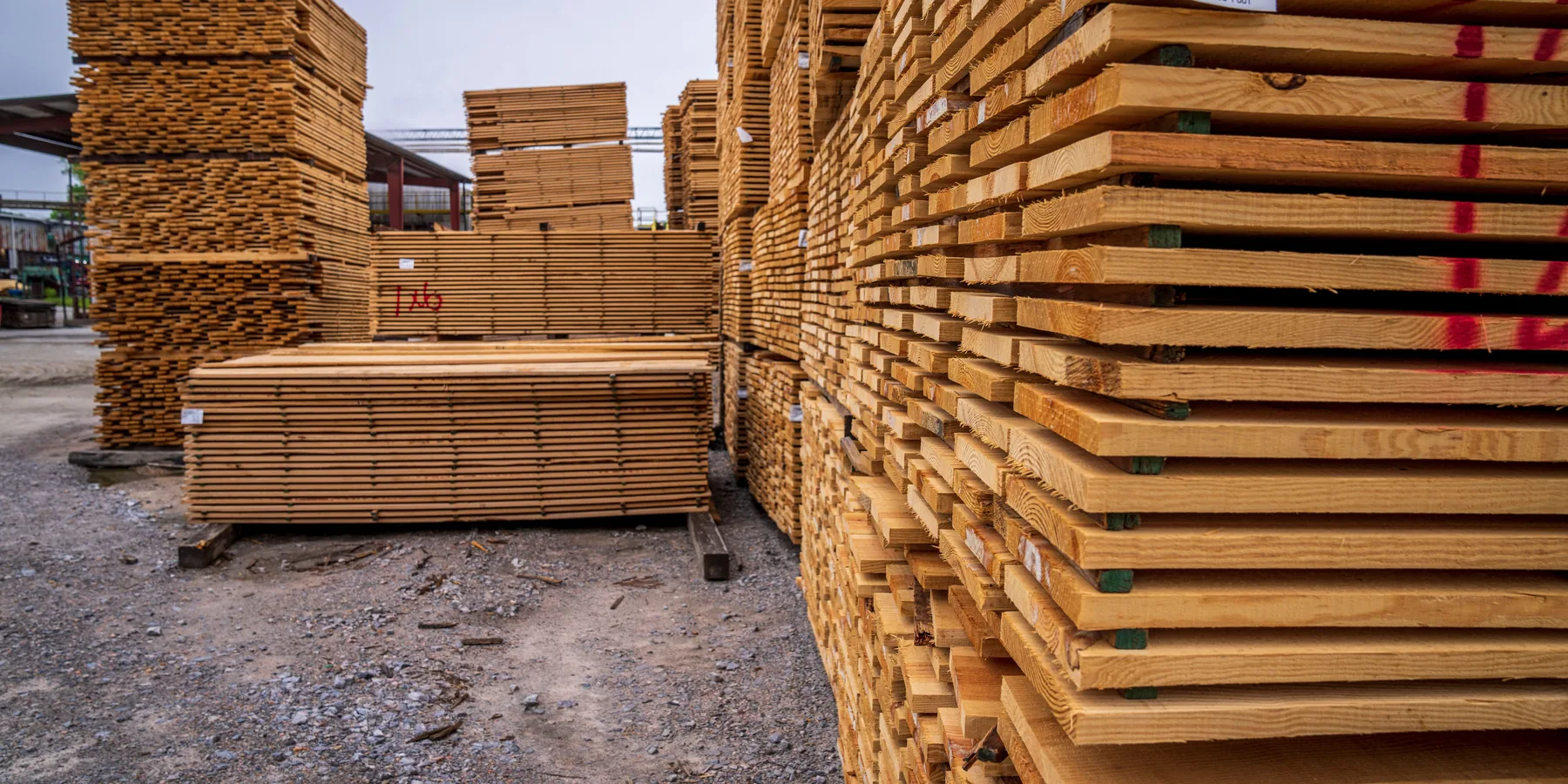
Treated pine and cedar deck boards come in even lengths: most yards stock 8, 10, 12, 16 and 20 ft, and some carry 14 and 18 ft as well. Composite and PVC boards come in fewer lengths — commonly 12, 16 and 20 ft.
The length to buy depends on the joists as much as on the deck. Where two boards meet end to end the joint has to land on a joist, so a length that divides into whole joist bays wastes nothing. On 16 in centres, 8, 12, 16 and 20 ft all do; a 10 ft board reaches the joist at 9 ft 4 in and the last 8 in is cut off.
| Board run | Buy | Cut off per row |
|---|---|---|
| 8 ft | One 8 ft board | Nothing |
| 10 ft | One 10 ft board | Nothing |
| 12 ft | One 12 ft board | Nothing |
| 14 ft | One 16 ft board, or 14 ft where stocked | 2 ft |
| 16 ft | One 16 ft board | Nothing |
| 20 ft | One 20 ft board | Nothing |
| 24 ft | 16 + 8, 12 + 12 and 8 + 16 in turn | Nothing, joints staggered |
Runs longer than the longest board are joined, and the joints are moved from row to row so no two in neighbouring rows share a joist. The deck material calculator plans that cut for your deck and the lengths you can buy, and counts the boards of each length.
Decking board width and coverage
Across a deck each board takes its width plus one gap. That gives the linear feet of board in every square foot of deck — the number that turns an area into an order.
| Board | Gap | Board + gap | Linear ft per sq ft | 100 sq ft deck |
|---|---|---|---|---|
| 5½ in wood | 3/16 in | 5.6875 in | 2.11 ft | 211 ft of board |
| 5½ in composite | 1/4 in | 5.75 in | 2.09 ft | 209 ft of board |
| 3½ in wood | 3/16 in | 3.6875 in | 3.25 ft | 325 ft of board |
That is before cuts. A deck whose boards run in one stock length has almost none; one that needs joined boards or a diagonal lay loses more, and the calculator works out how much from the actual cut plan rather than a flat percentage.
Composite decking sizes
Composite and PVC boards are made rather than milled, so their sizes are the maker's, not the sawmill's. Most sit close to 1 × 5½ in and come in 12, 16 and 20 ft lengths, with grooved edges for hidden clips or square edges for face screws. Wider boards and thinner "deck tiles" exist, but the standard board follows wood decking so the same framing works for both.
Two things differ from wood. Composite grows with heat along its length, so it wants a wider end gap and a wider side gap — usually ¼ in — and its makers set their own joist spacing rather than following the code table below.
Joist spacing for each board
A thin board spans less between joists. The 2021 IRC sets the widest joist spacing for wood decking by thickness, and a diagonal lay needs closer joists because the board crosses them at a slant.
| Board | Square to the joists | 45° diagonal |
|---|---|---|
| 5/4 wood (1 in) | 16 in | 12 in |
| 2 × wood (1½ in) | 24 in | 24 in |
| Composite / PVC | Maker's figure, commonly 16 in | Commonly 12 in |
For boards continuous over three or more joists. How far the joists themselves may span is in deck joist and beam span tables, and local codes can be stricter than the model code — the building department has the final word.
Count the boards for your deck →More in this series
The rest of the deck
These tables set how far the frame can reach. Every deck tool on the site works inside them.
- Deck Material Calculator Deck boards by length, joists, beam, posts, hangers and screws or hidden clips
- Deck Stair Stringer Calculator Stringers, treads, risers and the cut that keeps every step even
- Deck Stain Calculator Gallons of stain for the deck floor and every face of the railing
- Deck Railing and Post Spacing Calculator Railing posts, balusters under the 4 in rule, rails, brackets and screws
- Deck Footing Sizes and Spacing Form tube sizes, pad size by load and soil, and frost depth
- Deck Joist and Beam Span Tables Joist spans by species, size and spacing, beam spans, cantilevers and ledger fasteners