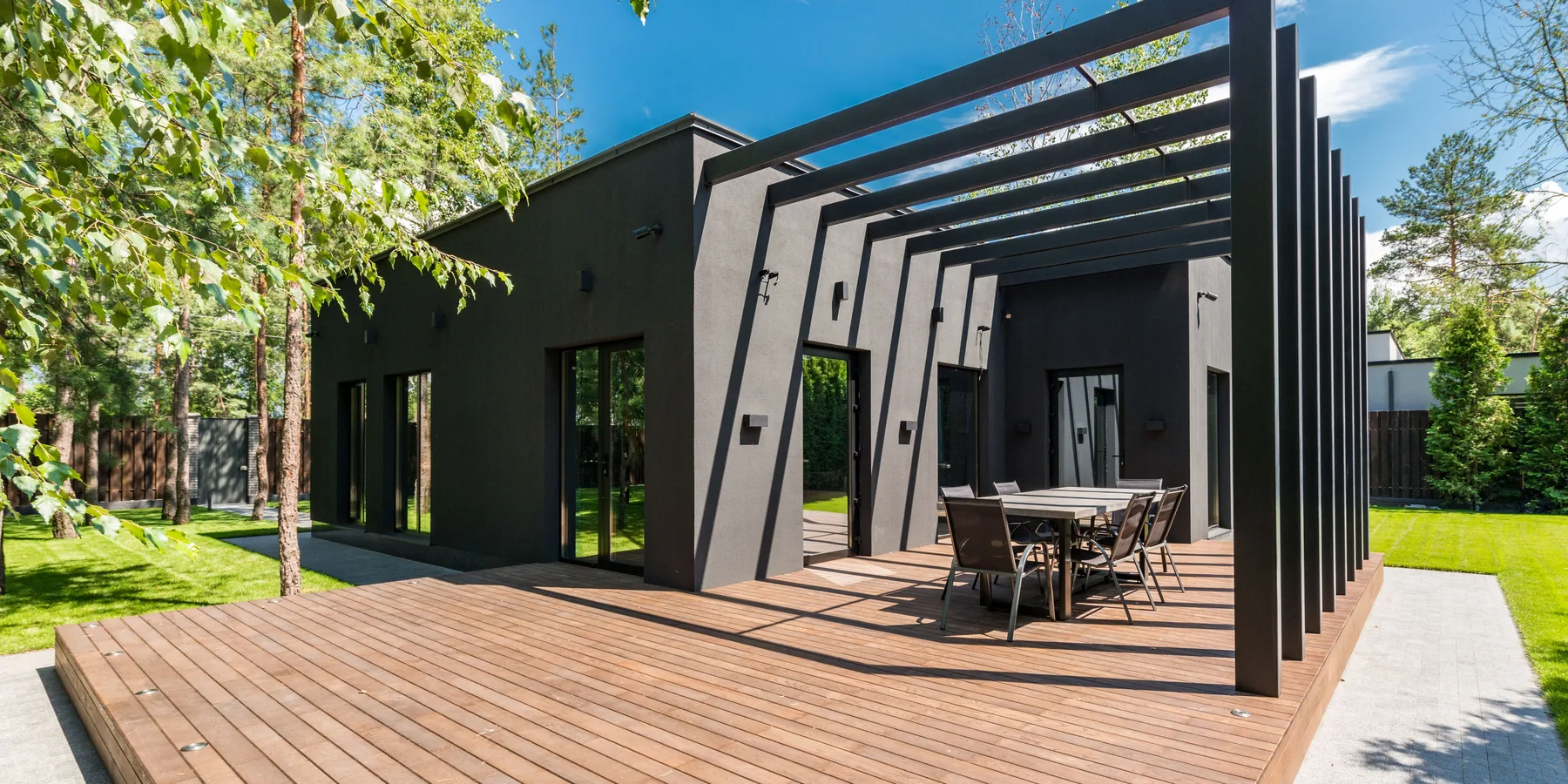
Deck calculator
Deck material calculator:
boards, framing and cost
Count deck boards the way a yard sells them — by length — with every joint landing on a joist. Then the frame underneath: joists, ledger, rim, beam and posts, checked against the code span tables, plus the screws or hidden clips, and a price for the lot.
Enter your deckOptional
What will it cost?
Every material the calculator worked out gets its own price. Each field starts at a typical US figure so you have something to work from — change any of them to what your own supplier charges.
These prices are approximate. They are national US retail figures, and what you actually pay varies with your region, your supplier, the season and how much you buy at once. Treat them as a starting point, not a quote — always price the job from your own supplier's current figures before you order.
Your prices
More in this series
Build the rest of the deck
This page counts the boards and the frame under them. The stairs, the railing and the finish are separate jobs with their own maths, and each has its own tool.
- Deck Stair Stringer Calculator Stringers, treads, risers and the cut that keeps every step even
- Deck Stain Calculator Gallons of stain for the deck floor and every face of the railing
- Deck Railing and Post Spacing Calculator Railing posts, balusters under the 4 in rule, rails, brackets and screws
- Deck Footing Sizes and Spacing Form tube sizes, pad size by load and soil, and frost depth
- Deck Joist and Beam Span Tables Joist spans by species, size and spacing, beam spans, cantilevers and ledger fasteners
- Deck Board Sizes and Lengths Nominal and actual decking sizes, stock lengths, coverage and joist spacing

Based on your result
What you'll need
Quantities update after every calculation. Order the boards in one delivery — treated lumber and composite both vary in colour between batches.
- Deck boards
- By length, joints over joists
- Calculate above
- Joists and hangers
- One hanger per joist at the ledger
- —
- Beam and posts
- Posts at the spacing the beam table allows
- —
- Screws or clips
- Two screws per board at every joist
- —
- Fascia
- Finish boards over the rim and end joists
- —
- Footings
- One under every post
- See the footing calculator
The maths
How this deck material calculator works
A deck is not a floor. Its boards span open air between joists, so a board may only end where there is a joist under it — an end that lands between two joists springs every time it is stepped on and works its screws loose within a season. That one rule decides where every cut goes, and it is why deck boards are counted by length rather than by square foot.
Deck board calculator: rows and lengths
Rows are the deck's width divided by one board plus one gap. Along each row the calculator uses one board when a stock length covers the run; when none does, it joins two over a joist, never on a joist a joint used in either of the two rows before, and cuts short pieces from the offcuts before it buys another board.
Lumber estimator for the deck frame
Joists are the length divided by the spacing, plus one, each as long as the deck is wide. The ledger and the rim each run the length; the beam is the length times its plies; posts go under the beam at the spacing the IRC beam table allows for that joist span.
joists = ⌈ length ÷ spacing ⌉ + 1
joint = only where a joist crosses the row
screws = 2 × boards × joists crossed
posts = ⌈ length ÷ beam span ⌉ + 1
- 01
Lay out the rows
The width across the boards, one board and one gap at a time. The last row takes whatever is left, and the result says when that means ripping a board.
- 02
Find the joists
One every spacing from the ledger end, and always one at the far rim. On a diagonal the boards meet them √2 times further apart.
- 03
Cut only to a joist
Every joint lands on a joist line. A 10 ft board on 16 in centres can only reach the joist at 9 ft 4 in, and the rest is waste — the calculator counts it.
- 04
Stagger the joints
No joint shares a joist with one in either of the two rows before it, so the deck never shows a seam running across it.
- 05
Reuse the offcuts
A piece left over from one row is cut into the next wherever it reaches. The cut waste shown is what that really leaves, not a flat percentage.
- 06
Check the frame
The joist size against the IRC span table, the joist spacing against what the boards allow, and the posts against the beam table.
Materials
Composite deck cost and wood deck cost
The same deck costs very different amounts to board depending on what it is boarded with, and the difference is almost all in the board price. The frame underneath is pressure-treated lumber either way.
| Boards | Per linear foot | Gap | 16 × 12 deck, boards only |
|---|---|---|---|
| Pressure-treated deck boards | $0.90 – $2.20 | 3/16 in | $374 – $915 |
| Cedar deck boards | $2.50 – $5.50 | 3/16 in | $1,040 – $2,288 |
| Composite deck boards | $2.50 – $6.50 | 1/4 in | $1,040 – $2,704 |
| PVC deck boards | $3.50 – $8.00 | 1/4 in | $1,456 – $3,328 |
416 linear feet: 26 sixteen-foot boards. Typical US prices — change them in the cost panel above.
Composite and PVC change more than the price. They move with heat, so they want a wider gap, and their makers commonly ask for joists at 12 in rather than 16 in when the boards run on a diagonal — the calculator warns when the spacing you chose is wider than the boards allow. Wood boards take their limit from the code: IRC Table R507.7 allows 16 in square to the joists and 12 in on a diagonal for 5/4 decking.
Where this calculator stops
The count runs down to the top of each post. What the posts stand on is its own job: the concrete footing calculator sizes the piers and their concrete, and the post hole calculator covers posts set straight in the ground. How far apart the footings go, and how big each one has to be, is in deck footing sizes and spacing.
Good to know
Deck questions, answered
With 5/4 × 6 boards at a 3/16 in gap, a deck 16 ft along the house and 12 ft out takes 26 rows. Each row is one 16 ft board, so the order is 26 boards of 16 ft with nothing to cut but the ends. Run the boards the other way and each row is 12 ft instead: more rows, shorter boards.
A deck board spans open air between joists. An end that stops between two joists has nothing under it, so it flexes every time it is stepped on and pulls its screws loose. Every joint goes over a joist, with a screw or two into it from each board.
Sixteen inches on centre is the usual spacing for wood boards laid square to the joists, and it is the most wood decking the code allows at 1¼ in thick. Diagonal boards need joists closer — 12 in — and composite follows the maker, which is also commonly 12 in on a diagonal.
In southern pine at 40 psf, the 2021 IRC allows 13′-1″ at 12 in centres, 11′-10″ at 16 in and 9′-8″ at 24 in. Other species span less, and snow loads shorten all of them. The full tables are in the deck joist and beam span guide.
It is a finish choice, not a requirement. A frame hides the board ends around the edge, but the frame boards need blocking under them where they run along a joist, and the field has to fit inside it — the calculator shrinks the field and counts the frame boards separately.
Screws are cheaper and quicker, and hold wood decking well. Hidden clips leave a clean surface and suit composite; they sit in grooved board edges, one at every board at every joist, with starter clips along the first board.
At typical US prices for pressure-treated pine, the boards, frame, hangers, screws and 4 posts for a 16 × 12 deck come to roughly $1,313, before footings, stairs and railing. Composite boards more than double the board line. Enter your own prices in the cost panel.