Reference
Pavers vs concrete patio
A paver patio is hundreds of small units laid on compacted gravel and sand; a concrete patio is one poured slab. The slab is cheaper to build. The pavers are stronger unit for unit, usable the day they go down, and can be lifted and relaid instead of broken out.
Which costs less? Plain concrete: about $4–10 per sq ft installed with a broom finish, against $8–25 for pavers. For a 12 × 16 ft patio that is roughly $768–1,920 for concrete and $1,536–4,800 for pavers. Stamped or stained concrete closes most of the gap, and small jobs often carry a minimum charge that lifts the per-foot price.
Pavers vs concrete patio, side by side
| Concrete pavers | Poured concrete slab | |
|---|---|---|
| Compressive strength | 8,000 psi average minimum (ASTM C936) | 4,000–4,500 psi where it freezes (ACI 332); the IRC's porch-and-steps row is 2,500–3,500 psi |
| Water absorption | 5% average maximum | Not specified; relies on 5–7% entrained air where it freezes |
| Thickness | 2-3/8 in (60 mm) pavers | 4 in slab |
| What goes under it | 4 in compacted gravel base + 1 in bedding sand, with edge restraint | Compacted subgrade or gravel |
| Joints | Sand-filled joints between every unit | Control joints about 8 ft apart, cut 1/4 of the slab deep |
| Ready to use | Immediately after compaction | Walk on it after 24 h, furniture after 3 days, cars after 7 |
| Repairs | Lift and relay the same pavers | Saw out and patch, or replace the panel |
| Installed cost | $8–25 per sq ft | $4–10 per sq ft, broom finish |
The strength figures measure different things — a paver is tested as a single unit, a slab as the mix that is poured — (ASTM C140 for pavers, C39 for concrete cylinders), so they say more about freeze-thaw and wear than about which patio "holds more". A patio carries foot traffic either way. For a residential driveway the same 2-3/8 in pavers go on a 6 in base.
Paver patio vs concrete patio cost per square foot
| Cost guide | Paver patio, installed | Concrete patio, installed |
|---|---|---|
| HomeGuide | $10–17 / sq ft | $5–10 / sq ft (plain broom finish; $5–15 with decorative finishes) |
| Angi | $8–25 / sq ft | $4–7 / sq ft (smooth or broom finish; $4–30 with stamping and staining) |
The concrete calculator works out the cubic yards and bags for a slab, with a cost panel, and the paver calculator counts pavers, base gravel, bedding sand and joint fill. Paver weights and pallet counts are in the paver sizes and weights guide.
Price a concrete patio →How each one is built
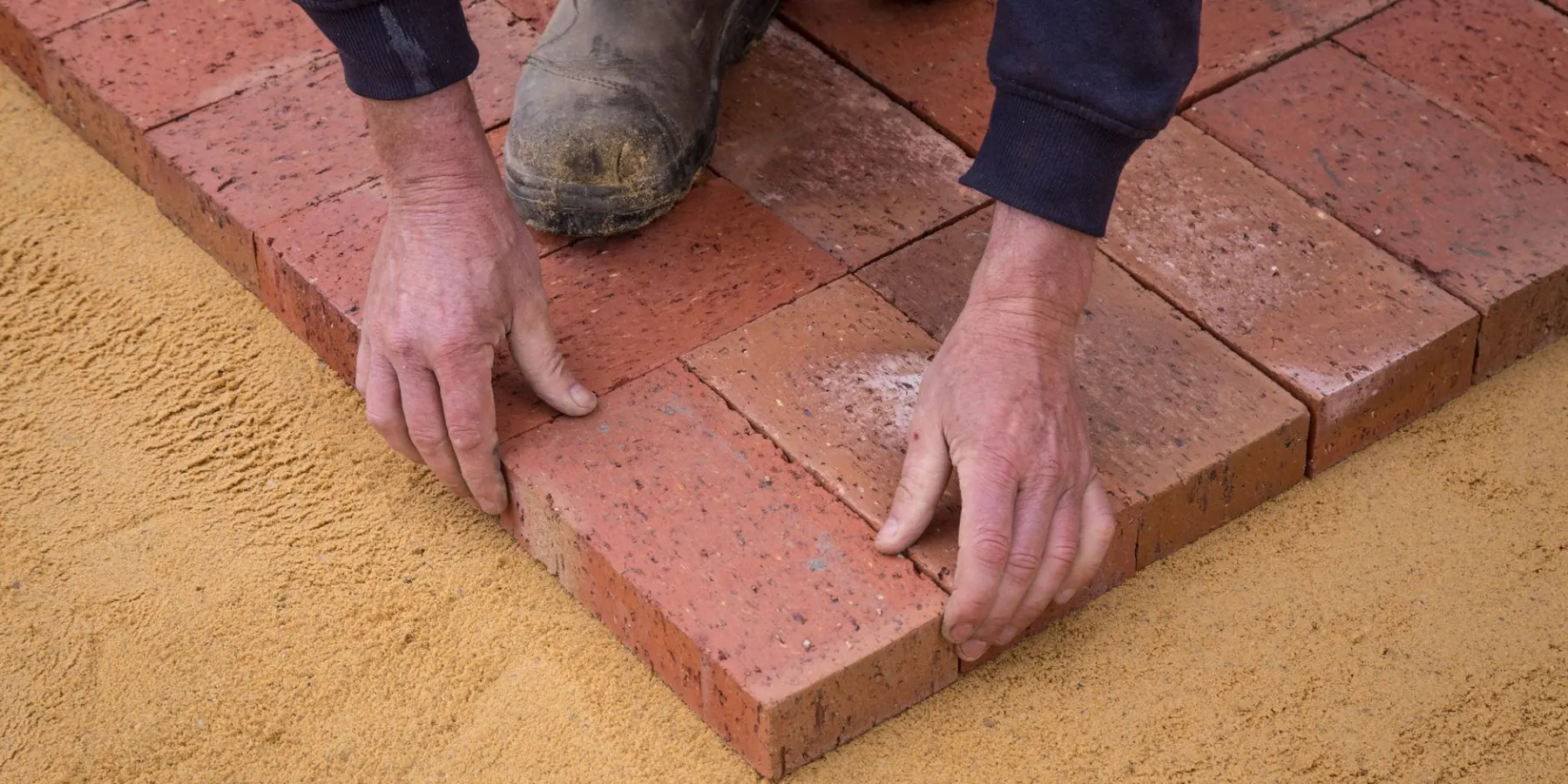
- Pavers: dig out, compact the soil, lay and compact at least 4 in of crushed gravel base (more on wet or weak soil and in cold climates), set edge restraint, screed 1 in of bedding sand, lay the pavers, compact them, sweep sand into the joints and compact again. It is usable as soon as it is compacted.
- Concrete: dig out, compact the base, set forms, pour and finish a 4 in slab, and cut control joints at no more than twice the slab thickness in feet — 8 ft for 4 in, up to 10 ft with coarse aggregate — with panels no longer than 1.5 times their width. Order 4,000–4,500 psi air-entrained concrete where winters freeze. Walk on it after 24 hours and keep cars off for 7 days; the concrete curing guide has the timeline.
Figures: Pavers: CMHA Tech Note PAV-TEC-002-22 (ICPI Tech Spec 2, rev. March 2022) for ASTM C936 strength and absorption, the 4 in minimum compacted base under patios and walks and the 1 in uncompacted bedding sand; ICPI Tech Spec 10 (rev. March 2022) for 2-3/8 in pavers on patios, ready for traffic immediately, and lifting and reinstating the same pavers for repairs. Concrete: IRC Table R402.2, the code's nearest row (porches, carport slabs and steps exposed to the weather: 2,500, 3,000 and 3,500 psi for negligible, moderate and severe weathering, air-entrained 5–7%); ACI 332 as summarised by the Virginia Ready-Mixed Concrete Association (Bulletin #6: 4,500 psi where exterior concrete freezes wet or sees deicers) and the Michigan Concrete Association driveway and sidewalk guidelines (4,000 psi; control joints at no more than twice the slab thickness, 8 ft for 4 in; 4 in minimum thickness). Walk, furniture and vehicle times: the site's concrete curing data (resources/data/concrete-times.json). Unit vs cylinder strength: ASTM C140 tests a paver, ASTM C39 a concrete cylinder. Edge restraint and compaction sequence: ICPI Tech Spec 2. Installed cost: HomeGuide and Angi cost guides, read 2026-10-31. Prices are national ranges; local quotes vary.
Good to know
Pavers vs concrete questions
No — plain concrete is cheaper: about $4–10 per sq ft installed against $8–25 for pavers. Stamped or colored concrete costs close to pavers.
A concrete paver must average at least 8,000 psi under ASTM C936; exterior slabs in freeze-thaw areas are ordered at 4,000–4,500 psi under ACI 332. Pavers also average no more than 5% water absorption, which helps in freeze-thaw.
Yes. Pavers are ready for traffic as soon as they are compacted. A concrete slab can be walked on after about 24 hours, takes furniture after 3 days and cars after 7.
At least 4 in of compacted gravel over well-drained soil, plus 1 in of bedding sand. Wet or weak soils and cold climates need a thicker base.
How long either lasts comes down mostly to the base and drainage under it. The difference is repair: pavers that settle or heave can be lifted and relaid, while a cracked slab is patched or replaced.
Tools for the job
What makes this job easier
Tools and materials that suit this kind of job. These are affiliate links: if you buy through one, Renovimo may earn a commission at no extra cost to you. It never changes the figures on this page.
 Garvee
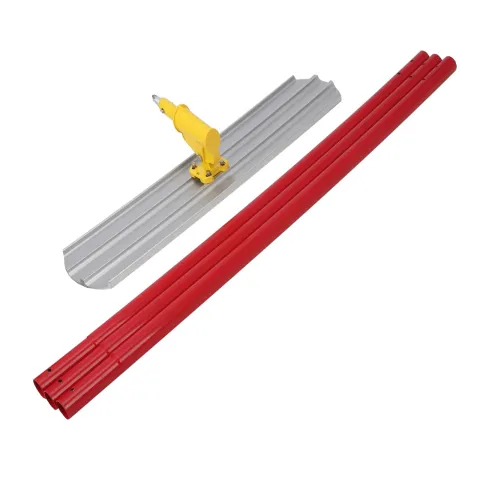
Bull float, 48 × 8 in
Levels a fresh slab and brings up the cream for finishing.
Check price
 Garvee
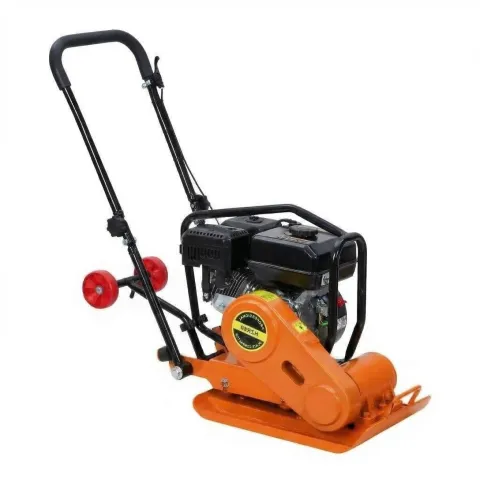
Plate compactor, 7 HP
Compacts gravel base in lifts so pavers and walls do not settle.
Check price
 Plastic Place
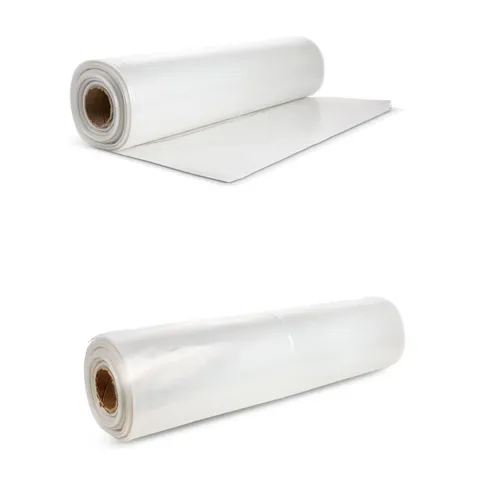
Poly sheeting, 6 mil, 10 × 100 ft
The vapor barrier under a slab on grade; lap the seams 6 in and tape them.
Check price
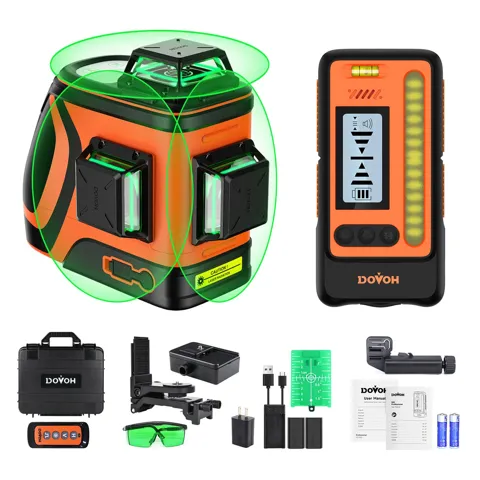 Dovoh
Outdoor laser level with receiver
The receiver finds the beam in full sun, so you can set forms, footings and base to grade alone.
Check price
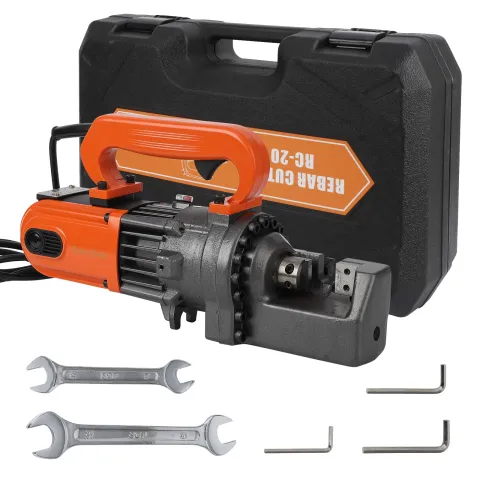 Garvee
Electric rebar cutter, up to #6
Cuts slab and footing bar to length in seconds, with no sparks.
Check price
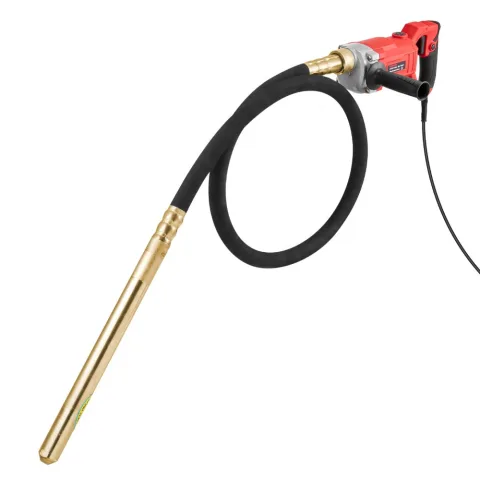 VEVOR
Concrete vibrator, 800 W
Shakes the air pockets out of fresh concrete in forms and around rebar, so the face comes out without honeycombing.
Check price
Not the tool you were after? Browse the whole range at Garvee, Plastic Place, Dovoh or VEVOR — the stores these picks come from.