
Fence calculator
Fence calculator:
posts, pickets, rails and concrete
A fence is counted from the posts out. Enter each side and the gates, pick the style and height, and get the posts, the rails between them, the pickets on the rails and the concrete each post sits in.
Enter the fenceOptional
What will it cost?
Every material the calculator worked out gets its own price. Each field starts at a typical US figure so you have something to work from — change any of them to what your own supplier charges.
These prices are approximate. They are national US retail figures, and what you actually pay varies with your region, your supplier, the season and how much you buy at once. Treat them as a starting point, not a quote — always price the job from your own supplier's current figures before you order.
Your prices
More in this series
Put these figures to work
Sizing one part of a pour is easier when the slab itself is settled. Start with the main estimate, then come back for the detail.
- Concrete Calculator Concrete volume, ready-mix bags, gravel base and rebar
- Rebar Calculator Grid bars, lap splices, tie wire and steel weight
- Post Hole Concrete Calculator Concrete per hole, bags, gravel base and total yards
- Concrete Footing Calculator Piers, bell footings, strip footings, form tubes and yards
- Concrete Steps Calculator Stepped volume, landing slab, bags and cubic yards
- Self-Leveling Compound Calculator Underlayment bags, average depth, primer and coverage
- Concrete Removal Cost Calculator Debris weight, dumpsters and demolition cost
- Concrete Bag Yields and Mix Ratios Bag yields, mix proportions and strength classes in one table
- Self-Leveling Concrete Thickness Minimum and maximum pour depth, gravel fills, and bags per 100 sq ft by thickness
- Concrete Curing and Drying Times When you can walk, load and drive on new concrete, how temperature changes it, and how long mortar takes
- Concrete Weight per Cubic Foot and Yard What a cubic foot, a cubic yard and a slab of concrete weigh, by type and thickness, and what a truck carries
- Fence Post Depth, Spacing and Sizes How deep to set a fence post by fence height, how far apart posts go by style, 4×4 or 6×6, bags of concrete per post, and how long each wood lasts
Tools for the job
What makes this job easier
Tools and materials that suit this kind of job. These are affiliate links: if you buy through one, Renovimo may earn a commission at no extra cost to you. It never changes the figures on this page.
 Garvee
Two-wheel wheelbarrow
Carries bagged concrete, gravel and bundles of pickets down the line to each post hole; stable on two wheels.
Check price
 Garvee
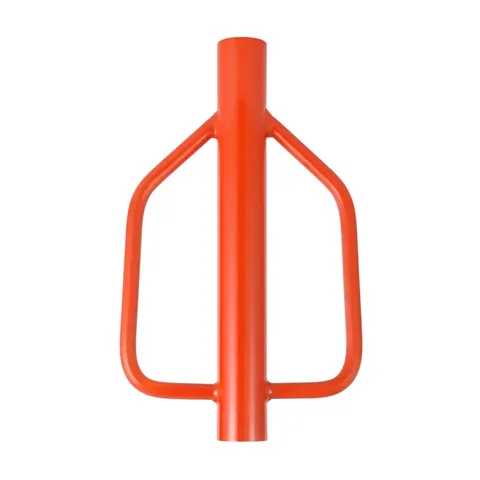
Fence post driver, 18 lb
Drives the T-posts and stakes that hold the string line, and the posts of a chain-link run, without a sledge.
Check price
 Dovoh
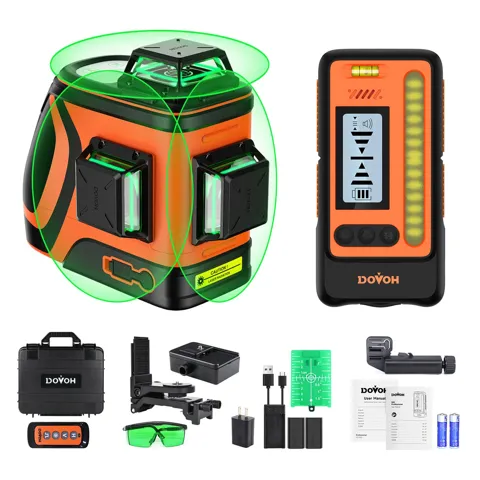
Outdoor laser level with receiver
Shoots one level beam along the run so every post top, and so every rail, lands at the same height.
Check price
 Garvee
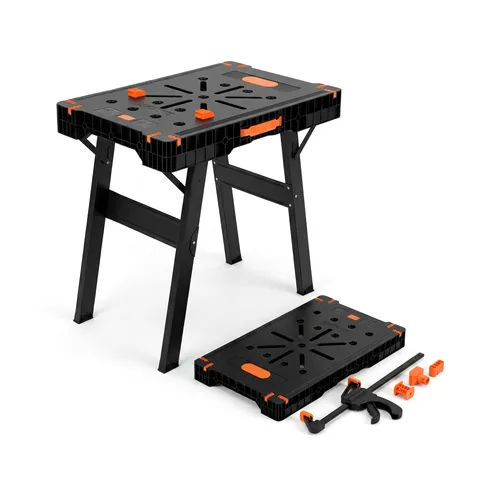
Folding work table and sawhorse
Holds pickets and rails at cutting height while you trim them to length and cut the dog-ears.
Check price
 Garvee
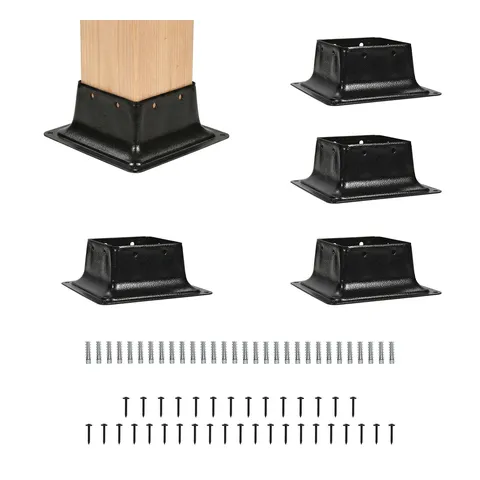
Stainless post base, 4-pack
Lifts a 4×4 off the concrete so the end grain stays dry.
Check price
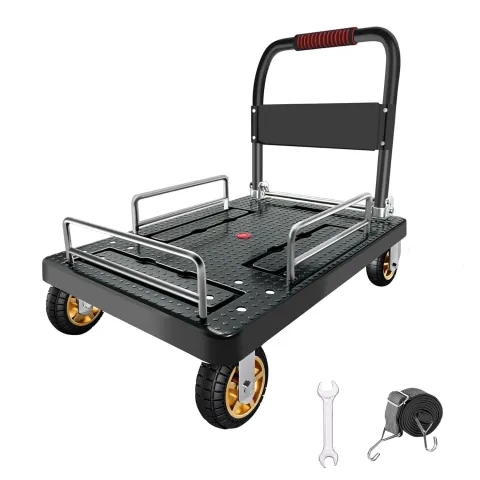 Garvee
Folding platform truck, 1300 lb
Stacks a pallet-load of concrete bags or a bundle of boards on to a platform for the walk from the drive to the fence line.
Check price
Not the tool you were after? Browse the whole range at Garvee or Dovoh — the stores these picks come from.

Based on your result
What you'll need
Quantities update after every calculation. Set the posts first, string a line along their tops, then hang the rails and boards to it.
- Posts
- Treated, rated for ground contact
- Calculate above
- Rails
- One span between posts: treated 2×4 for a board fence, split rail or a top rail for the others
- —
- Boards or fabric
- Boards for a wood fence (on a shadowbox half go on each face), rolls for chain link
- —
- Pre-built panels
- One 6 × 8 ft panel for each 8 ft section
- —
- Post caps Amazon
- One for every post
- —
- Concrete
- Bags of the size you chose, waste included
- —
- Gravel
- Under every post, for drainage
- —
- Rail fasteners Amazon
- Two ends on every rail; 3 screws or one bracket for each end
- —
- Screws Amazon
- Exterior-rated, two at every board and rail, plus the rail-end screws
- —
- Gate hardware Amazon
- A pair of hinges and a latch for every gate; a drop rod on a double gate
- —
- Gate leaf frames
- 2×4 Z-frame (two stiles, two rails, one diagonal) for each leaf
- —
- Terminal posts
- 2⅜ in pipe: ends, corners and gate posts
- —
- Line posts
- 1⅞ in pipe, one every 10 ft
- —
- Tension bars and bands Amazon
- A bar at each end and gate post (two at a corner) with bands to hold it
- —
- Brace bands and rail ends Amazon
- One of each wherever the top rail meets a terminal post
- —
- Dome and loop caps Amazon
- Dome caps on terminal posts, loop caps on line posts
- —
- Fence ties Amazon
- One per foot on line posts, one per 2 ft on the top rail
- —
- Tension wire Amazon
- Along the bottom of the fabric, the length of the fence
- —
As an Amazon Associate I earn from qualifying purchases.
The maths
How many fence posts do I need?
Posts come first: one at each end of every side and one every 6 to 10 feet between, with a gate adding a post of its own and a corner shared by two sides counted once. Everything else is counted from the posts.
sections on a side = ⌈ (side − gates on that side) ÷ spacing ⌉ (zero if the side is all gate)
posts = Σ (sections + 1 + gates on that side) − shared corner posts
rails = sections × rails per section · boards = ⌈ fenced length × 12 ÷ (board width + gap) ⌉ + the gate leaves
panels = sections (pre-built mode, no loose boards or rails)
concrete per post = hole volume − post volume (the post hole calculator's maths)
bags = ⌈ Σ concrete cu ft × (1 + waste) ÷ bag yield ⌉, rounded up once for the whole job
caps = posts · rail fasteners = rails × 2 ends × 3 screws (or 1 bracket)
gate hardware = a pair of hinges + a latch per gate leaf, a drop rod per double gate
The concrete per post is the same figure the post hole calculator gives for the same hole, and the bags are totalled the same way (one round-up for the whole job), so the two pages agree. For chain link, terminal posts (ends, corners, gate posts) are 2⅜ in pipe, line posts 1⅞ in pipe, both in 8 in holes; tension bars, bands, brace bands and rail ends follow the terminal posts, and ties follow the line posts and the top rail.
- 01
Measure each side
A corner ends a side. Measure from the outside face of one end post to the other.
- 02
Take the gates out
Each gate is its own width; that length is not fenced, but it adds a post.
- 03
Divide by the spacing and round up
Eight feet for a privacy or picket fence, ten for split rail and chain link. Divide the fenced part of each side (the side less its gates), round up, and add one post for the end of the run and one for each gate. Then take off the corners where two sides meet.
- 04
Count the rails and pickets
Rails by height, boards by their width plus the gap (a shadowbox overlaps them by 1½ in), with each gate boarded like the fence. Each side rounds up on its own. Then add the caps, the rail fasteners and the gate hardware.
- 05
Size the concrete by the hole
A third of the post goes in the ground on top of 6 in of gravel, in a hole about three post widths across. The post hole calculator turns that into bags; the bag total is rounded up once for the whole job. Wide gate posts are sized as 6×6 in a bigger hole.
Pickets and concrete
Fence calculator: pickets, rails and concrete per post
| Style | Picket width | Gap | Pickets per 100 ft |
|---|---|---|---|
| Privacy (solid board) | 5.5 in | 0 in | 219 |
| Picket | 3.5 in | 2.5 in | 200 |
| Shadowbox (board on board) | 5.5 in | overlap 1.5 in | 300 |
| Fence | Post | Hole | Concrete per post | 80 lb bags |
|---|---|---|---|---|
| 4 ft | 4×4 | 12 in × 30 in deep | 1.4 cu ft | 3 |
| 5 ft | 4×4 | 12 in × 36 in deep | 1.75 cu ft | 3 |
| 6 ft | 4×4 | 12 in × 42 in deep | 2.1 cu ft | 4 |
| 8 ft | 6×6 | 16 in × 54 in deep | 4.74 cu ft | 8 |
The depth rule, the bag sizes and how long each wood lasts are in the fence post depth, spacing and sizes guide. To work one hole out on its own, use the post hole calculator.
Good to know
Fence calculator questions, answered
14 posts at 8 ft spacing, which is a privacy or picket fence, and 11 at 10 ft. At 6 ft spacing it is 18. A gate adds one post. Sides that meet at a corner share the corner post, so a 100 ft front and a 40 ft side take one post fewer than two separate fences.
About 219 boards of 5.5 in for a solid privacy fence. A picket fence with a 2.5 in gap takes 200 pickets of 3.5 in, and shadowbox, which overlaps, takes 300.
For a 6 ft fence, a 4×4 in a 12 in hole 42 in deep takes about 2.1 cu ft, which is 4 bags of 80 lb mix. Shorter fences take less; the table above has each height.
A third of the post goes in the ground: 24 in for a 4 ft fence, 30 in for a 5 ft fence, 36 in for a 6 ft fence, 48 in for a 8 ft fence, plus 6 in of gravel under the post. Where the ground freezes, go below the frost line. The guide has the full chart.
Terminal posts (2⅜ in pipe) at every end, corner and gate, line posts (1⅞ in) between them, a top rail, a tension bar and 3 to 5 tension bands on each terminal post, a brace band and rail end where the rail meets it, dome and loop caps, ties every foot on line posts and every 2 ft on the rail, and tension wire along the bottom. The calculator counts all of it.
Two for a 4 ft fence, three for 6 ft and four for an 8 ft solid privacy fence. Split rail uses two or three, and chain link one top rail.